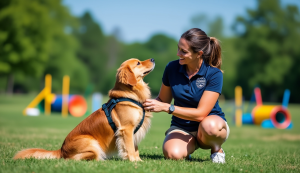

Management prevents a dog from rehearsing the wrong behavior today. Training teaches the dog what to do in that situation over time. Gates, leashes, crates, distance, and closed doors are not proof that training failed; they are often what makes useful training possible.
I understand why owners resist management. They want the dog to be “fixed,” not separated from the door or kept on leash. But removing every safety measure before the skill is ready does not prove the training. It gives the old behavior another chance to win.
A good plan tells you which part is management, which part is training, and what evidence would justify changing the setup.
Management changes access, not the dog’s understanding
A baby gate can stop a dog from rushing a visitor. A leash can prevent a dog from reaching another dog. A crate can protect a puppy and the house when direct supervision is impossible. Distance can keep a reactive dog under better control.
Those tools change what can happen in the moment. They do not automatically teach a replacement behavior. If the dog is always behind a gate but never practices a calm doorway routine, the gate may remain necessary because the missing skill was never taught.
Training changes the dog’s usable options
Training gives the dog a behavior they can perform and you can reinforce: go to a place, walk with a loose leash, wait for release, return when called, or disengage from a distraction.
The trained behavior has to be built below the point where the dog loses the ability to respond. That is why management and training overlap. The gate can create enough space to practice place. The leash can keep a recall rehearsal safe. Distance can let the dog notice a trigger without exploding toward it.
The management tool is not replacing the lesson. It is controlling the classroom.
Use a two-column plan
For one problem, write two columns:
- Prevent today: What stops the dog from practicing the dangerous or unwanted behavior?
- Teach for tomorrow: What specific behavior will the dog practice instead?
For door rushing, prevention might be a leash and gate before the door opens. Training might be a place cue, a wait, and a release practiced with quiet door movements. For counter surfing, prevention might be clearing food and blocking the kitchen; training might be settling on a mat while food is prepared.
If you cannot name the second column, you have a containment plan but not yet a training plan. If you cannot name the first, you may be letting the dog rehearse the problem faster than you can teach the alternative.
Do not remove management based on one good repetition
One calm greeting does not establish reliability. Before reducing a safety layer, ask:
- Has the dog succeeded across several sessions?
- Has the skill worked with more than one person or setup?
- Can the dog recover when the situation becomes a little harder?
- Can you restore control quickly if the dog makes a mistake?
- Would failure create a safety risk?
The last question matters most. The higher the cost of failure, the slower you should be to remove the backup.
Management can be a long-term quality-of-life decision
Not every management tool has to disappear. A dog may learn better visitor behavior and still rest behind a gate during a crowded party. Dogs may live peacefully together and still eat in separate rooms. A dog may have a strong recall and still use a leash where laws, traffic, or the environment require it.
That is not giving up. It is matching freedom to the situation rather than taking a risk to prove that the dog is trained.
When management is telling you to get help
If the setup keeps becoming more restrictive, the dog is escalating, or the household cannot use the plan safely, the case needs another set of eyes. Bite history, guarding, escape behavior, intense reactivity, and sudden behavioral change all raise the threshold for professional or veterinary input.
NC K9’s dog training evaluation guide can help you record the exact situations, triggers, and safety measures already in use. If the behavior includes aggression or reactivity, review the role of behavior modification training rather than treating the issue as ordinary obedience.
The question is not, “When can I stop using the gate?” The better question is, “What has the dog learned, where has it worked, and what backup does this situation still deserve?”