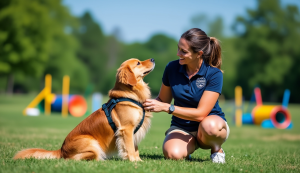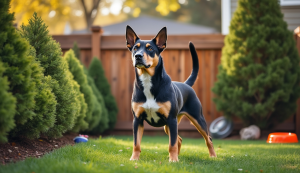

When a dog explodes at the doorbell, the useful question is not “How do I stop the noise?” It is “What should the dog do while I handle the door?” A clear place away from the entrance, enough distance to think, and a rehearsed routine give the dog an answer. Trying to teach that answer for the first time while a real guest is waiting usually asks too much.
The doorbell is a chain of events: sound, movement toward the door, the door opening, a person entering, and attention shifting around the room. Train the chain in pieces before expecting calm through the whole sequence.
Begin with management, not a command
If your dog may rush through the door, jump on a visitor, or make contact, use a leash, gate, closed interior door, or another secure barrier before training begins. Management keeps a surprise delivery from becoming a safety test.
Choose a station that is far enough from the entrance for the dog to settle: a bed, mat, crate, or gated area. The dog should be able to stay there without being crowded by the person entering. Distance is part of the plan, not a sign that training has failed.
Teach the place before adding the bell
Practice going to the station when nothing is happening. Reward the dog for moving to it, then for remaining there briefly while you take one step away. Build duration and your movement gradually.
Do not add the doorbell until the dog can find the station in a quiet room. If the dog cannot stay while you touch the doorknob, asking for the same behavior through a full visitor arrival is too large a jump.
Break the visitor sequence into five rehearsals
- Door movement without a visitor: walk toward the door, return, and reward calm at the station.
- A quiet knock or low-volume recording: pair the sound with movement to the station.
- The door opening a few inches: reward the dog for staying in place while the door moves.
- A familiar helper outside: the helper appears briefly and leaves before the dog loses control.
- A short entry: the helper enters, ignores the dog, and allows you to reward continued calm.
Only change one difficult piece at a time. A louder bell, an unfamiliar person, a longer visit, and a fully opened door are four separate increases. Combining them can hide which part the dog does not understand.
Give visitors a job too
Many greetings become harder because the visitor immediately leans over the dog, reaches out, makes excited eye contact, or calls the dog’s name. Ask the helper to enter calmly and ignore the dog until you decide whether interaction is appropriate.
Your dog does not have to greet every visitor. For some households, staying behind a barrier with a safe activity is the successful outcome. Calm separation is better than a forced greeting that pushes the dog beyond what they can handle.
Track recovery, not just barking
Record how long it takes the dog to return to ordinary breathing, respond to a familiar cue, or settle on the station after the trigger. A dog who barks twice and recovers may be making more useful progress than a dog who is silent but remains rigid and unable to disengage.
Also note which part of the chain causes the first change. Some dogs react to the sound. Others remain calm until the person crosses the threshold. That distinction tells you where to simplify the next rehearsal.
When doorbell manners become a behavior case
Do not run practice arrivals on your own if the dog has attempted to bite, redirected onto a handler, broken through barriers, or shown intense fear or aggression toward visitors. Secure the dog before people enter and seek professional help. Sudden behavior changes or signs of pain also warrant veterinary input.
If the reaction is part of a broader pattern around the home, NC K9’s article on territorial dog behavior explains signs and triggers to observe. The guide to leash reactivity can help when the same dog also struggles to create space on walks.
For ordinary skills and household routines, review NC K9’s private training program. If visitors create a safety concern rather than simple overexcitement, begin with the behavior modification program so the history and risk can be evaluated honestly.