A dog can look comfortable around other dogs in one setting and bark, lunge, or strain at the leash in another. That difference is real, but it does not tell you by itself whether the dog is aggressive. The leash changes how the dog can move, how close the trigger feels, and how much control the dog believes it has over the situation.
If you want to understand the pattern, stop trying to name it from one bad walk. Start by noticing what changes before the reaction begins.
The Leash Removes Options
Off leash, a dog may approach in an arc, slow down, move away, sniff the ground, or create more space. On leash, the path is narrower. The owner may keep walking forward while the dog is already uncomfortable, or the leash may tighten just as another dog gets close.
That restriction can add frustration for a dog that wants to reach something. It can add pressure for a dog that wants to get away. It can also make an already difficult behavior feel bigger because the dog learns that barking or lunging changes what happens next.
None of those explanations should be treated as a diagnosis. Two dogs can show the same outward reaction for different reasons, which is why the details around the behavior matter more than the label an owner chooses.
Watch the First Change, Not Just the Explosion
Most owners remember the loudest part: the barking, the lunge, the scramble to shorten the leash. The useful information often appears earlier.
You may notice the dog close its mouth, stop sniffing, lean forward, raise its head, stare, change pace, or become unable to respond to something it normally knows. Those smaller changes tell you the dog is already moving toward a reaction.
Once the dog is fully committed to the outburst, you have fewer good choices. You are managing the moment, not teaching through it. Learning to recognize the beginning gives you a chance to create space before both you and the dog are overwhelmed.
Keep a Four-Part Walk Log
You do not need a complicated journal. After a difficult moment, write down four things:
- The trigger: another dog, a runner, a bicycle, a person, a vehicle, or something else.
- The distance: a rough estimate of how far away it was when you noticed the first change.
- The first visible sign: what the dog did before barking or lunging.
- The recovery: how long it took before the dog could move, sniff, respond, or settle again.
After several walks, the pattern is often more informative than your memory of the worst incident. Perhaps the dog reacts only when another dog appears head-on. Perhaps distance matters more than the type of dog. Perhaps the reaction is worse near home, in narrow spaces, or after several difficult encounters close together.
This log is also useful if you request a professional evaluation because it gives the trainer observable events instead of a broad statement like “my dog hates other dogs.” Our article on preparing for a dog training evaluation explains how those details improve the first conversation.
Your Handling Can Change the Picture Without Causing the Whole Problem
Owners sometimes hear that leash reactivity is entirely their fault because they became nervous or tightened the leash. That is too simple. Your handling can influence the moment, but it may not be the original reason the dog struggles.
What does matter is that dogs learn patterns around us. If you brace every time you see another dog, shorten the leash only after the dog is already staring, or continue moving closer because you hope this encounter will be different, the setup becomes harder to manage.
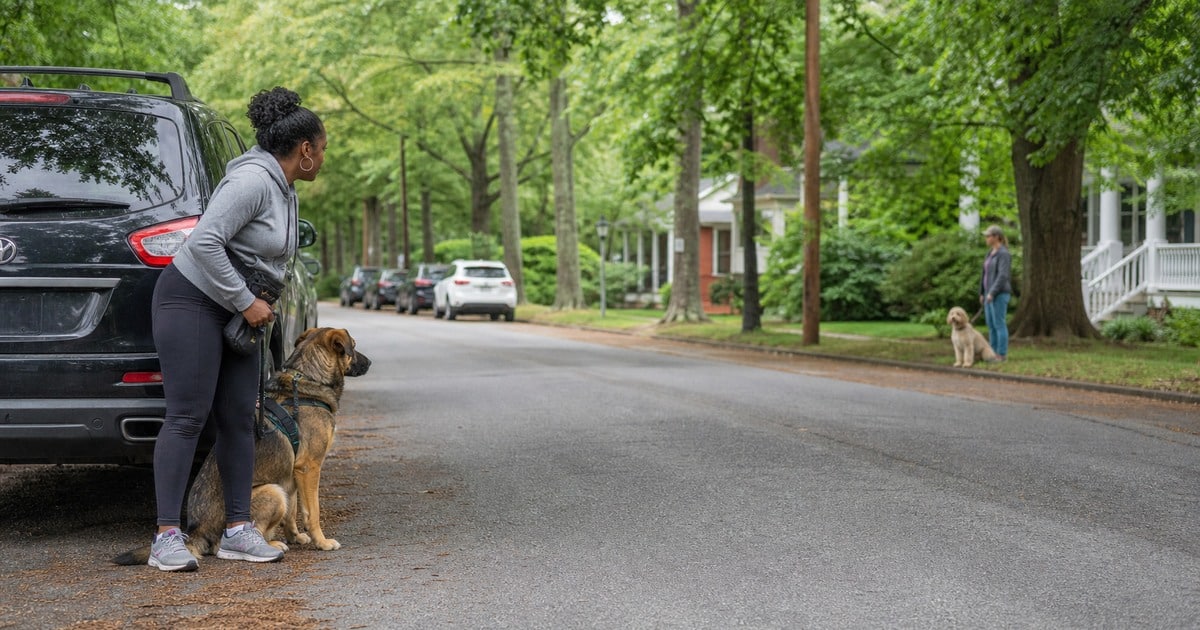
The goal is not to pretend you are relaxed. The goal is to make earlier decisions. Cross the street before the leash becomes a wrestling match. Use parked cars or a driveway to create room. Choose a walking time and route that let you observe the dog instead of surviving one close encounter after another.
Do Not Use Surprise Encounters as Training Tests
A common mistake is to keep exposing the dog to difficult situations in the hope that repetition will make the reaction disappear. Repetition only helps when the dog is able to learn something useful. If every encounter ends with barking, lunging, and being dragged away, the dog is rehearsing the same response.
For now, management has value. Distance, route choice, visual barriers, and fewer uncontrolled greetings can reduce the number of reactions while you work out what the dog needs. That is not giving in to the behavior. It is preventing practice of the behavior you are trying to change.
If the dog has bitten, attempted to bite, redirected onto the handler, or become difficult to control physically, do not use public encounters as experiments. The safety threshold has changed, and the next step should be professional guidance rather than another test walk.
When the Change Is Sudden, Consider the Dog’s Health
Pain, discomfort, sensory changes, and other health issues can affect how a dog responds to movement, restraint, or proximity. If the behavior appeared suddenly, became much more intense, or is accompanied by other physical or behavioral changes, speak with your veterinarian.
Training guidance cannot diagnose a medical cause. A trainer and veterinarian may have different roles in understanding the same change.
Bring the Pattern to the Evaluation
The useful question is not simply, “Is this aggression?” It is: what happens before the reaction, what conditions make it more likely, how much control does the handler have, and what level of risk is present?
NC K9’s article on dog aggression and reactivity in Raleigh explains why similar-looking behaviors should not automatically receive the same plan. If the behavior is tied to guarding the home, yard, windows, or doorway rather than walks, the guide to territorial dog behavior may be a better starting point.
You do not have to solve the label before asking for help. Give the trainer the pattern, the history, and the safety details. That is what allows the recommendation to move beyond a guess.