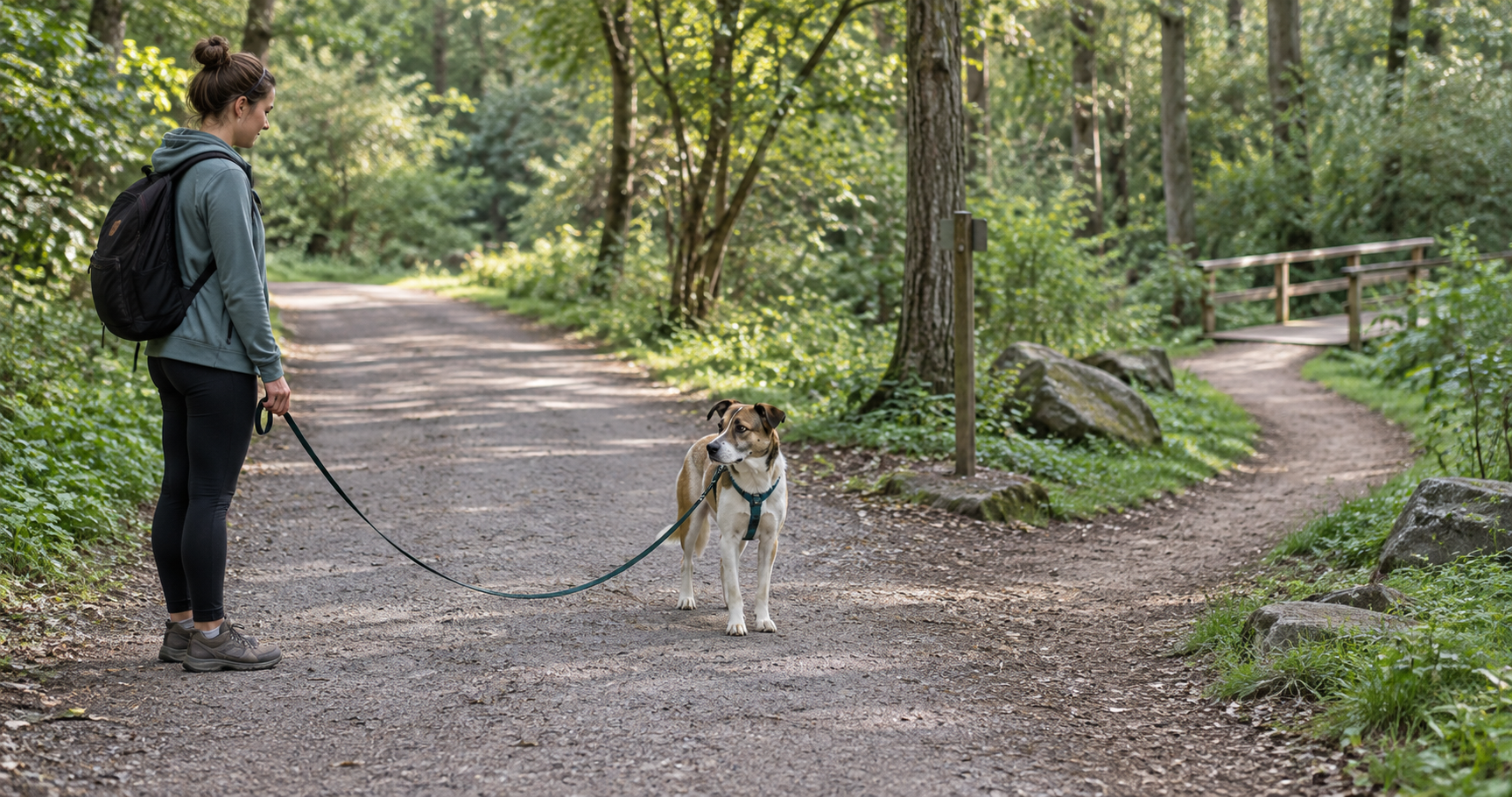
If your dog freezes on a walk, don’t pull harder just because the leash stopped moving. Pause, check the environment and the dog’s body, and decide whether the next safe step is more space, a different route, or ending the walk.
A planted dog can be frustrating when you are trying to get somewhere. But “won’t walk” does not tell you why the dog stopped. The dog may be worried about something ahead, reluctant to leave something behind, overwhelmed by the setting, uncomfortable in equipment, tired, or in pain. Your first job is not to win the standoff. It is to sort the possibilities without making the moment more dangerous.
Check the Surroundings, Equipment, and Your Dog
Look where the dog is looking. Listen for construction, machinery, barking, or a sound you had filtered out. Notice posture: weight shifted back, head low, closed mouth, scanning, trembling, or a stiff body. Then check the practical basics—surface temperature, weather, equipment fit, paw condition, and the distance already walked.
Do not crowd, drag, or lure the dog closer to a person, animal, or object that may be causing fear. VCA’s veterinary overview of fear responses includes freezing as a possible signal of discomfort and notes that medical conditions can contribute to fear-related behavior. An article cannot tell you which cause applies to your dog.
Use a three-choice pause
When the location is safe, give yourself three choices rather than one demand:
- Create space. Step sideways or back toward the easier area and see whether the dog’s body softens.
- Offer an alternate path. A small arc or turn can be easier than continuing straight toward the concern.
- End the outing safely. If the dog cannot recover, continuing may only rehearse distress.
A reward can help if the dog is willing to take it, but food is not proof that the dog feels safe. Do not trail food toward the feared thing or use it to keep a dog moving through pain. Reward choosing the easier path, reconnecting with you, or taking a comfortable step away.
Map the route after the walk
At home, mark the exact location, time, direction of travel, surface, weather, and anything present. Was the dog willing to return by another route? Did the freeze occur at the same corner or after a similar amount of activity? A pattern helps separate a location-specific concern from a broader movement or health change.
Our dog-training evaluation preparation guide shows how to bring observations without trying to diagnose the dog yourself. If the freeze is new, frequent, paired with limping or sensitivity, or happens in multiple ordinary settings, start with your veterinarian. If it involves panic, escape attempts, lunging, or a situation you cannot manage safely, seek qualified in-person help.
Rebuild from the last comfortable point
If health and safety concerns have been addressed, practice near the easiest edge of the pattern—not in the middle of the shutdown. That might mean standing at the driveway, walking a shorter loop, or observing the difficult location from farther away. Let comfortable movement and recovery, not distance traveled, define success.
It’s frustrating to stop when you’re trying to get somewhere. But if you can work out what made your dog hesitate, you’ll be better placed to choose more space, another route, or a shorter outing.