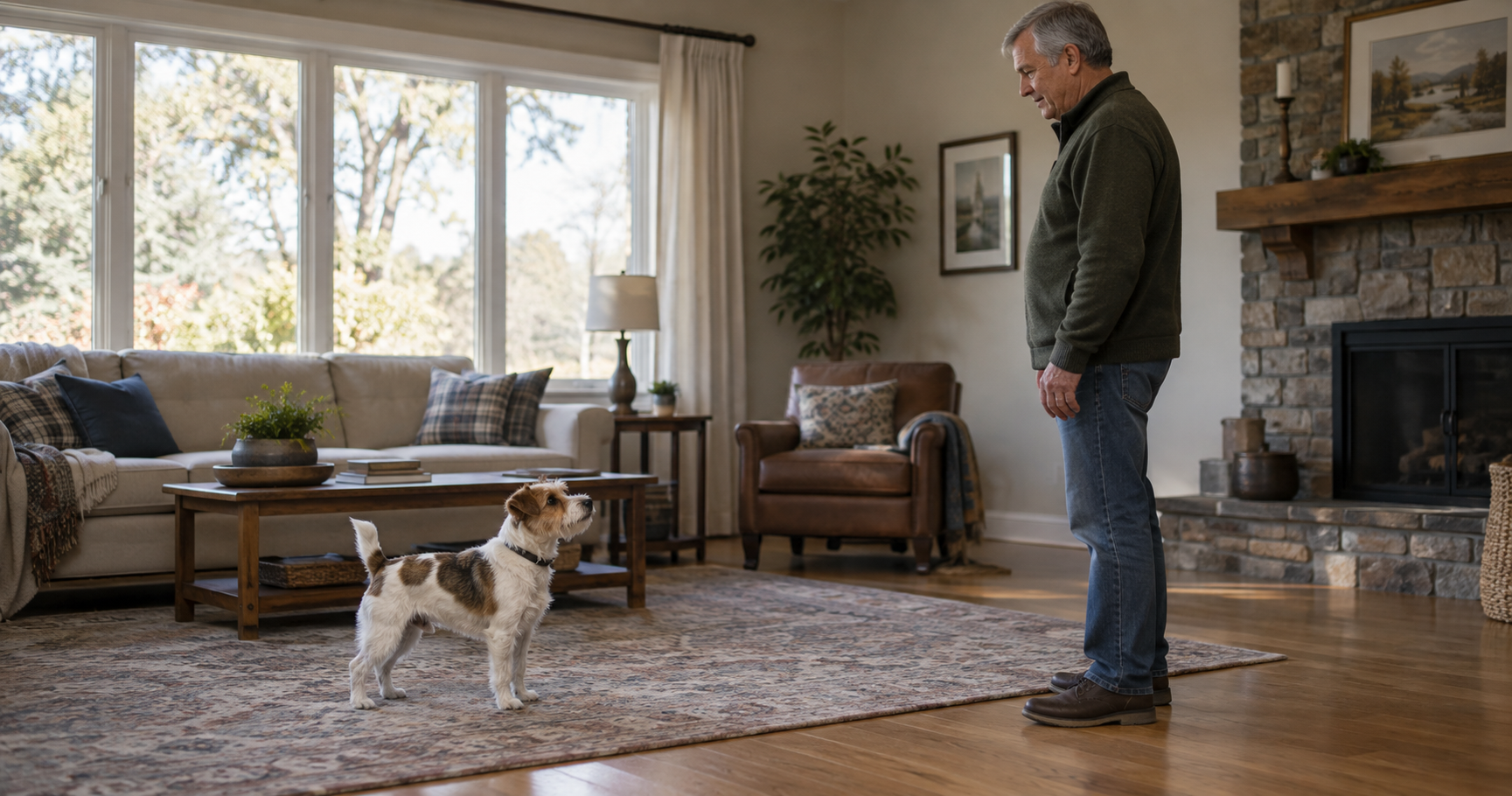
If you have to repeat a command before your dog responds, stop adding repetitions and check what the dog is actually responding to. The first word may be getting lost in a distraction, the dog may be waiting for your hand signal, or the repeated phrase may have become the familiar cue.
That doesn’t make the dog stubborn, and it doesn’t mean you’ve ruined the training. But saying “sit” a fourth time won’t tell you which part is unclear. Before we ask for a quicker response, we need to make one request understandable.
Listen to the whole cue you’re giving
Pick one comfortable, familiar behavior in a quiet room. Watch your own sequence: do you say “down,” bend at the waist, point at the floor, and then say “down” again? The dog may be responding to the pointing. From your side, it feels as though the second word worked. From the dog’s side, the useful information arrived later.
The AKC’s guidance on common training mistakes identifies repeated cueing as a habit that can weaken clear communication. The useful lesson isn’t to become stern about saying a word once. It’s to change the next attempt when the first request doesn’t work.
Try a small observation, not an obedience test
Have rewards ready but out of sight, choose a nonslip surface, and wait until your dog is available to engage. Don’t interrupt sleep or ask for a physically uncomfortable position. Give your familiar cue once, then leave a brief, quiet moment for a response.
If the dog performs the behavior, mark it with your established marker word and reward. If nothing happens, don’t stand over the dog repeating yourself. Relax, reset your position, and make the next attempt easier. That might mean moving to a quieter room or using the familiar hand signal to refresh the movement.
Keep a tiny record for a few easy attempts:
- What came first? The word, a gesture, or a reach toward food?
- What happened? The dog began the behavior, watched your hand, looked elsewhere, or moved away.
- What changed next time? One clearer signal or an easier setting, rather than a louder voice.
Those notes are observations, not a score for the dog. A response to a gesture but not the word suggests a different lesson from a dog who can’t engage in that room at all.
Give the word a useful job
If the hand signal is reliable and the word isn’t, say the word just before the familiar gesture. Mark and reward the completed behavior. After several comfortable repetitions across short sessions, leave a small pause before the gesture. If your dog starts the movement on the word, let them finish and reward; the extra gesture isn’t needed on that attempt.
If the dog still needs the gesture, keep teaching rather than repeatedly testing the word alone. Make the signal smaller gradually as the response becomes clear. You don’t need to make food vanish, either. Our guide to dogs who listen only when treats are visible explains how to separate the cue from the sight of the reward.
Suppose your dog lies down when you point but waits when you only speak. Today’s useful work is pairing that word with a movement the dog understands. Asking from across the yard would add another problem before you’ve answered the first.
Keep safety separate from the lesson
Don’t practice a one-cue experiment beside traffic, at an open gate, or with an unsecured dog. Use physical management when an immediate safe outcome matters. A training cue is something you build; it isn’t a substitute for a leash or closed barrier.
And a sudden loss of familiar responses deserves a different question. If your dog seems painful, has trouble moving, appears not to hear, or changes behavior broadly, speak with your veterinarian. Fear, freezing, or aggression calls for an individual professional assessment, not more insistence.
For ordinary cue confusion, bring your short record to a trainer. NC K9’s private training sessions provide a setting to work on owner handling and the dog’s response together. The useful change starts before that appointment: make one request, notice what information the dog used, and improve the next repetition.