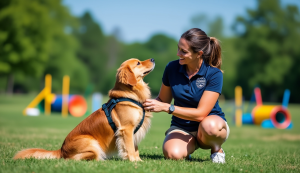

After a break from dog training, restart below the level where you stopped. Choose one or two foundation skills, make the first sessions short and easy, and rebuild reliability before adding the duration, distance, or distractions your dog handled in the past.
A rusty response is not proof that the dog forgot everything or became stubborn. The dog may be out of practice, the environment may have changed, and your own timing may be different. Treat the first week as a fresh baseline instead of a test the dog is expected to pass.
Check why the break happened
A vacation, busy season, move, new work schedule, or simple loss of routine calls for a gradual restart. A break caused by injury, illness, surgery, or a sudden behavior change needs veterinary guidance before you resume physical or demanding work.
Be honest about your own routine too. If five daily sessions are not realistic now, do not rebuild a plan that depends on them. Two useful minutes attached to something you already do can be more sustainable than a perfect schedule that lasts three days.
Run a five-skill baseline
In a quiet familiar place, check five practical responses: attention to name, sit or down, coming a few steps when called, waiting for release, and moving with you on leash. Give each cue once and note what happens.
Classify the result:
- Ready: the dog responds promptly and comfortably.
- Rusty: the dog responds after extra time or help.
- Not ready here: the dog cannot perform the behavior in this setup.
That small audit tells you where to begin. It also keeps one weak skill from turning into the unfair conclusion that all the training is gone.
Use a seven-day restart
- Days 1 and 2: practice two ready skills for a few successful repetitions.
- Days 3 and 4: help one rusty skill at the easiest level where the dog can win.
- Days 5 and 6: change one variable—slightly more time, a few more feet, or one mild distraction.
- Day 7: repeat the original baseline and compare responses.
End while the dog is still engaged. A restart is not the time to make up every missed repetition.
Restore the daily cues first
Prioritize behaviors that make ordinary life safer and clearer: coming when called on a long line, waiting at doors, walking without dragging you, releasing an object, and settling when the household needs calm. Tricks and advanced precision can return after the working routine is steady.
Attach practice to real moments. Ask for a brief wait before opening the door, reward attention before the walk, or practice a recall between two family members inside. The behavior becomes useful again because it belongs to the day, not only to a scheduled lesson.
Watch for evidence that this is not ordinary rust
Stop and seek appropriate help if the dog shows pain, fatigue, fear, aggression, disorientation, or a broad loss of skills. Older dogs and dogs returning after a medical event may need an adjusted plan. Do not push through a physical or emotional problem under the label of inconsistency.
If progress remains flat after you have lowered the difficulty and practiced consistently, the published dog training evaluation guide gives you a useful way to record what changed, and the program overview can help you choose the level of support that fits.
You are not trying to prove that the old training survived untouched. You are finding today’s starting point and rebuilding from evidence.