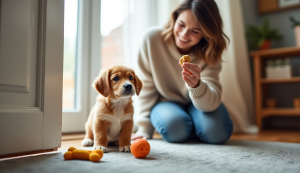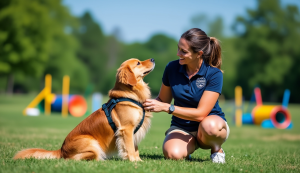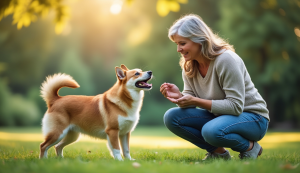

A dog who jumps on people does not need a louder correction. The dog needs one greeting rule that every person can make clear: attention starts when all four paws are on the floor, and it pauses when the dog jumps.
That sounds simple until the front door opens, the dog is excited, and a guest starts saying, “It’s okay, I don’t mind.” This is where most greeting plans fall apart. The dog is practicing one behavior while the people are trying to teach another.
When I help an owner with jumping, I separate the problem into three parts: prevent the full-speed rehearsal, teach the dog where to put their body, and train the humans to deliver the same consequence. You need all three.
Why jumping keeps working for the dog
Jumping often earns exactly what the dog wants: eye contact, hands, voices, movement, or a face close enough to investigate. Even pushing the dog away can become part of an exciting greeting. From the dog’s point of view, the jump started an interaction.
That does not mean you should stand still while a large dog knocks someone over. Safety comes first. Use a leash, gate, or separate room so the dog cannot reach a child, older adult, or anyone who is unsteady. Management prevents another bad repetition while you build a different habit.
Choose What Your Dog Should Do During a Greeting
“Do not jump” describes what you dislike, but it does not tell the dog what will work. Choose a visible replacement:
- all four paws remain on the floor;
- the dog sits before receiving attention; or
- the dog goes to a place and is released to greet later.
For many excited dogs, four paws on the floor is easier than holding a formal sit. The best rule is the one your household can recognize and reinforce consistently. Do not allow jumping in old clothes and punish it in work clothes. That is two different rules from the dog’s perspective.
Use a three-second greeting test
Start with one helper and the dog on leash. The helper approaches only while the dog can keep the chosen position. If the front paws leave the floor, the helper calmly turns and creates distance. The moment the paws return to the floor, the opportunity can begin again.
At first, ask for only a three-second greeting. End it while the dog is still successful. Then reset and repeat. This gives you a clean way to measure progress: Can the dog hold the greeting rule for three seconds with one familiar person? Five seconds? A person carrying a bag? A person who speaks excitedly?
Change one part at a time. If you add a new person, a tighter entryway, and more excitement in the same repetition, you will not know which part exceeded the dog’s current ability.
Pay the dog for the behavior you want
Attention itself can be the reward, but food can help you show the dog the correct position before the jump starts. Deliver the reward low, close to the floor, while the paws are down. If you wait until after the jump and then lure the dog down, you may accidentally create a chain: jump, get asked off, receive food.
The timing matters more than the number of treats. Watch the shoulders and front feet. Reward the quiet half-second before the dog launches, not only the recovery afterward.
Give guests a job before they enter
Your guest should not have to improvise while a dog is already in the air. Tell them the rule before opening the door: approach when the paws are down, turn away when they rise, and keep the first greeting quiet.
If the dog cannot stay under control, pause the greeting. There is nothing wrong with using a gate or another room and trying a planned repetition later. A chaotic visitor arrival is not a useful training test. NC K9’s guide to helping a dog stay calm when visitors arrive can help you separate the doorbell, entry, and greeting into smaller pieces.
Know when jumping is not the whole problem
Excited social jumping is different from behavior that includes stiff posture, growling, snapping, guarding space, or an inability to recover after the person leaves. Do not invite repeated greetings to “see what happens” when there is bite risk or fear. Use distance and physical separation, then ask for professional help.
For an ordinary greeting problem, keep a simple score for one week: person, location, whether the leash or gate was ready, and the longest calm greeting. That record will show you whether the dog is learning or merely succeeding with one person in one room.
You are not trying to make the dog less happy to see people. You are teaching the dog how to keep that greeting safe enough to enjoy.