
If your dog listens at home but seems to forget everything outside, that usually doesn’t mean your dog is choosing to be difficult. The skill was learned in one easier context, and the outdoor version adds distance, movement, smells, animals, people, and competing rewards faster than the training prepared for them.
The answer is not to repeat the cue more loudly in the hardest environment. Find the last place where the dog can still notice you, then build outward from there.
Outdoor Skills Need Their Own Practice
In the kitchen, the floor is familiar, the distance is short, and very little competes with you. On a Raleigh greenway, a dog may be processing bicycles, runners, wildlife, traffic noise, other dogs, damp grass, and the direction of every scent at once.
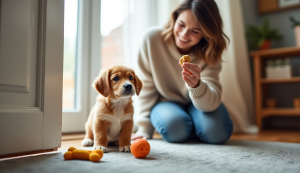
A behavior learned in one picture does not automatically transfer to every new one. That is why a dog can sit perfectly beside the refrigerator and appear confused by the same word in a parking lot. The outdoor version needs its own practice history.
Find the dog’s working distance
Working distance is the space where your dog can notice a distraction and still do something simple with you. That may mean turning toward you, taking a reward, following for a few steps, or responding to a familiar cue without repeated prompting.
If the dog is staring, pulling hard, vocalizing, freezing, or unable to take food they normally value, you may be too close or the environment may be too difficult. Create distance before asking for more control.
Practice in Three Gradually Busier Places
Choose three places between the living room and the busiest environment you ultimately care about:
- Threshold location: an open doorway, porch, garage, or quiet driveway where outdoor information is present but limited.
- Low-distraction location: a quiet corner of the yard or an uncrowded area at a calm time of day.
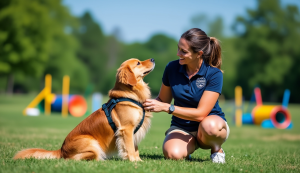
- Real-life practice location: the edge of a greenway, parking area, or public space where you can stay far from active distractions.
Practice the same small skill at each level. Do not make the cue harder, increase the distance, and add several distractions in the same session. Change one part, then see whether the dog can still succeed.
Use a one-minute check-in
Before beginning a walk, spend one minute observing what the dog can give you in that environment. Can they turn when you say their name once? Can they follow a step away from a smell? Can they take a reward and reorient, or are they immediately overwhelmed?
That minute helps you choose the day’s training level. It also prevents a common mistake: spending the entire walk asking for behavior the dog was not ready to perform at the starting point.
Make the environment part of the reward
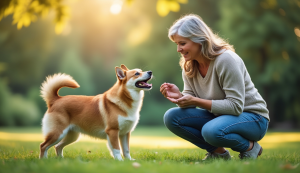
Food and toys can be useful, but the outdoors already contains powerful rewards. When safe and appropriate, a check-in can earn permission to go sniff. A few controlled steps can lead to exploring a new patch of grass. Returning to you does not always have to end the experience.
This helps the owner stop competing with the whole environment. The dog learns that working with you can be the path back to the things they wanted to investigate.
Know when “distracted” is not the full explanation
A dog who is curious and scattered needs a different plan from a dog who is afraid, reactive, or close to aggression. Watch for the first visible change. If the dog stiffens, scans, hides, lunges, growls, or cannot recover after a trigger passes, move away and treat the situation as a behavior concern rather than an obedience test.
Sudden changes, reluctance to move, sensitivity to touch, or altered stamina also deserve veterinary attention. Pain and illness cannot be corrected by asking for better focus.
Connect the outdoor problem to the right skill
If pulling is the main issue, use NC K9’s Raleigh loose-leash guide to build a distraction ladder around real walking environments. If the dog becomes reactive only when restrained, the guide to leash reactivity explains what to record before an evaluation.
For broader one-on-one help, review private dog training. Bring notes about the locations where the dog succeeds, the first place skills disappear, and which distractions create the biggest change. That gives the trainer a map instead of a vague report that the dog “doesn’t listen.”