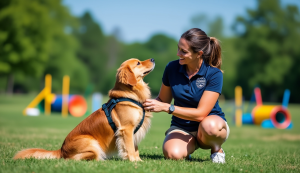

If your dog walks nicely in the driveway and pulls you down the street five minutes later, the dog has not forgotten how the leash works. The difficulty changed. A quiet practice area, a moving squirrel, a narrow sidewalk, and another dog across the road do not ask the same thing of the dog.
Loose-leash walking improves when you stop treating every walk as one skill and start noticing where the dog can still think.
First, Define What You Mean by Pulling
Some dogs lean into the leash from the moment the door opens. Others walk well until they see something they want. A young dog may zigzag because every smell is new. A stronger dog may pull hard enough that the owner cannot safely change direction or regain balance.
Those differences matter because “stop pulling” is not a complete training plan. You need to know when the leash becomes tight, what the dog is trying to reach or avoid, and whether you can get the dog’s attention before the pulling starts.
For the next few walks, notice three points:
- where the dog first moves ahead of you;
- what was happening in the environment at that moment; and
- whether the dog could still respond to you without physical struggle.
This tells you whether you are teaching your dog how to walk with a loose leash or trying to use it in a place that is already too hard.
Build a Distraction Ladder From Your Actual Walks
Dog owners in the Raleigh area do not all walk in the same environment. One person may start on a quiet Johnston County road. Another steps out of an apartment into a parking lot with people, dogs, delivery vehicles, and little room to move away.
Write down five places or situations you regularly encounter and put them in order from easiest to hardest. For example:
- inside the house or garage;
- the driveway or a quiet section of the yard;
- a calm residential block;
- a route with moderate foot or dog traffic; and
- the busy trail, shopping area, or time of day where pulling is strongest.
Your list may look completely different. What matters is that you stop judging the dog’s ability only at level five.
Work where you can create several clear repetitions, then move up one step. If the leash immediately becomes tight and the dog cannot respond, moving farther into the difficult setting usually gives you more pulling, not better practice.
Do Not Let the Destination Reward the Pull
Dogs repeat behavior that gets them somewhere. If pulling reaches the tree, the doorway, the other dog, or the end of the driveway, the tight leash becomes part of the route to the reward.
This does not mean every walk should become a constant stop-and-start contest. It means you should notice what the dog is earning. Slow down, change the path, create a small turn, or ask for a response the dog understands before continuing. The dog should learn that moving with you keeps the walk moving.
Timing matters. If you wait until the dog is at the end of the leash and fully focused on something else, you are beginning at the hardest moment. Give information while the dog can still use it.
Equipment Helps You Handle the Dog; It Does Not Teach by Itself
Leashes, collars, harnesses, and other training equipment affect leverage, communication, and safety. They can make a meaningful difference when they fit the dog, the owner, and the training approach. But no piece of equipment can decide when to give information, when to release pressure, when to create distance, or when the environment is too difficult.
Be cautious with any advice that presents one tool as the cure for every dog. The owner’s physical ability matters. The dog’s size, sensitivity, behavior history, and response to restraint matter too. If you cannot safely control the dog, get hands-on help before trying increasingly difficult public walks.
Separate Exercise From Leash Practice
Sometimes owners expect one walk to exercise the dog, expose it to the world, practice obedience, solve pulling, and leave everyone relaxed. That is a heavy workload for a dog that is still learning.
A short, deliberate leash session may be more useful than a long walk spent rehearsing tight-leash movement. Exercise and enrichment can happen in other safe ways while you improve the skill. The goal is not to cover a certain number of miles. The goal is to give the dog enough successful repetitions that walking with you starts to make sense.
Know When Pulling Has Become a Different Problem
A dog that pulls toward every smell is not presenting the same problem as a dog that barks and lunges at people or dogs. If the dog freezes, growls, redirects, becomes impossible to interrupt, or creates a safety risk, you may be dealing with reactivity or another behavior concern rather than ordinary leash manners.
NC K9’s existing dog aggression and reactivity article explains the safety and evaluation threshold.
Practice Where You Can Still Teach
Good leash work does not begin with proving the dog can handle the busiest route. It begins at the lowest level where the dog can notice the environment and still respond to the person holding the leash.
NC K9’s North Carolina dog-training program guide can help you distinguish ordinary skill-building from behavior work. If hands-on coaching with your dog sounds like the right starting point, the Private Dog Training page explains that option and includes the inquiry form.
When you ask for help, describe the easiest place your dog can walk without pulling and the point where the skill falls apart. That one comparison gives the trainer far more to work with than “my dog pulls everywhere.”