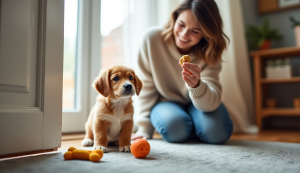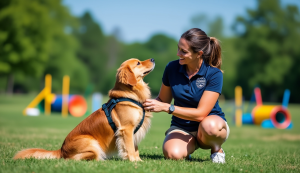

Puppy training starts the day the puppy comes home. That does not mean a young puppy needs long lessons, crowded public outings, or the same expectations you would place on an adult dog. It means the puppy is already learning from the household: where to sleep, how to get attention, what happens at doors, whether biting ends play, and whether people are predictable.
The better question is not, “What age can training begin?” It is, “What is this puppy ready to learn in this environment?”
The First Lessons Are Built Into the Day
During the first days at home, your biggest training tools are routine and repetition. The puppy does not need a complicated command list. The puppy needs a world that starts making sense.
You can begin teaching:
- that the puppy’s name predicts attention and connection;
- where potty trips happen and how often they are offered;
- how to rest in a crate, pen, or designated space;
- that gentle handling is normal;
- that four feet on the floor keeps greetings going; and
- that following you for a few steps can be rewarding.
These are short moments, not formal sessions that exhaust the puppy. A few clear repetitions before a meal, after a potty trip, or during play can teach more than one long session after the puppy has stopped concentrating.
Use Readiness, Not Just the Calendar
Two puppies of the same age may handle the same situation very differently. One settles quickly after seeing something new. The other becomes frantic, shuts down, or needs much more distance and rest.
Before making training harder, look at three things:
- Duration: Can the puppy stay engaged for a few useful repetitions without becoming tired or wild?
- Environment: Can the puppy notice what is around them and still eat, play, follow, or respond?
- Recovery: After something new, can the puppy settle and return to normal behavior?
If the answer is no, more exposure is not automatically better. Make the experience shorter, quieter, or farther away. Confidence grows when the puppy can process what is happening, not when the puppy is simply carried through as much novelty as possible.
Leash Foundations Can Start Before Long Walks
A puppy can learn to wear appropriate equipment, follow light guidance, move with you, and check in before the puppy is ready for a long neighborhood walk. Those foundations can begin in the house, driveway, or another controlled area.
Keep the goal small. At first, you are not asking for a polished heel. You are helping the puppy learn that the leash is not something to fight, bite, or drag against and that paying attention to the handler makes movement easier.
The existing guide to puppy training tips for new owners covers routines, recall foundations, boundaries, and confidence in more detail.
Socialization Is Not the Same as Meeting Everyone
A puppy does not need to greet every person or dog to learn about the world. Calm observation, controlled introductions, new surfaces, ordinary household sounds, short car rides, and different environments can all be part of early development.
The quality of the experience matters. If the puppy is overwhelmed, trapped, or unable to recover, repeated exposure can create the opposite of the confidence you wanted.
Health guidance matters here too. Your veterinarian should advise you about vaccinations, disease risk, and appropriate public exposure for your puppy. Training advice should not replace that medical guidance. You can still work on household skills and carefully controlled experiences while following the veterinarian’s recommendations.
As the Routine Stabilizes, Add Small Challenges
Once the puppy can sleep, eat, play, and settle with some predictability, begin asking for a little more. Practice a brief recall from a few feet away. Wait for a moment of calm before opening a door. Carry the same simple cue from the kitchen to the yard.
Change one part of the picture at a time. A puppy who responds in the living room may not understand the same request in a busy parking lot. That is not stubbornness. The environment became part of the lesson.
You should also expect progress to be uneven. Teething, growth, fear periods, sleep disruption, and changes in the household can affect what the puppy can handle on a given day. Watch what your puppy can handle now and make the next lesson a little harder when they’re ready. Puppies won’t all reach that point on the same schedule.
Do Not Wait for a Small Problem to Become the Routine
Some puppy behavior is normal and still needs guidance. Biting, jumping, chewing, pulling, barking for attention, resisting confinement, and having accidents do not make the puppy bad. But every day gives the puppy more practice, and practiced behavior becomes easier to repeat.
Ask for help when you cannot build a routine, when the puppy’s fear or distress is intense, when biting creates a safety concern, or when the household keeps giving the puppy conflicting answers.
If the puppy struggles specifically when left alone, the article on puppy separation anxiety and gradual independence explains what to observe and why sudden duration jumps can make the problem harder.
So, What Is the Best Age?
The best time to begin age-appropriate training is when the puppy enters your life. Begin with routine, attention, handling, rest, and clear household patterns. Add leash work and controlled exposure at a level the puppy can process. Increase difficulty when the puppy can stay engaged and recover, not simply because another week has passed.
Formal help can begin while those foundations are still being built. You do not need to wait for the puppy to develop a long list of problems, and you do not need to push a young puppy through adult-dog expectations to make an early start worthwhile.