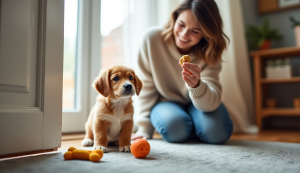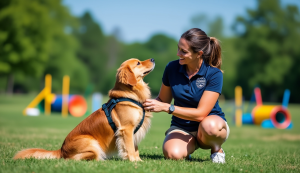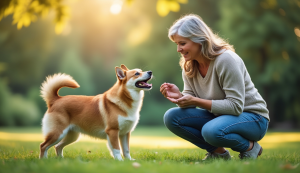
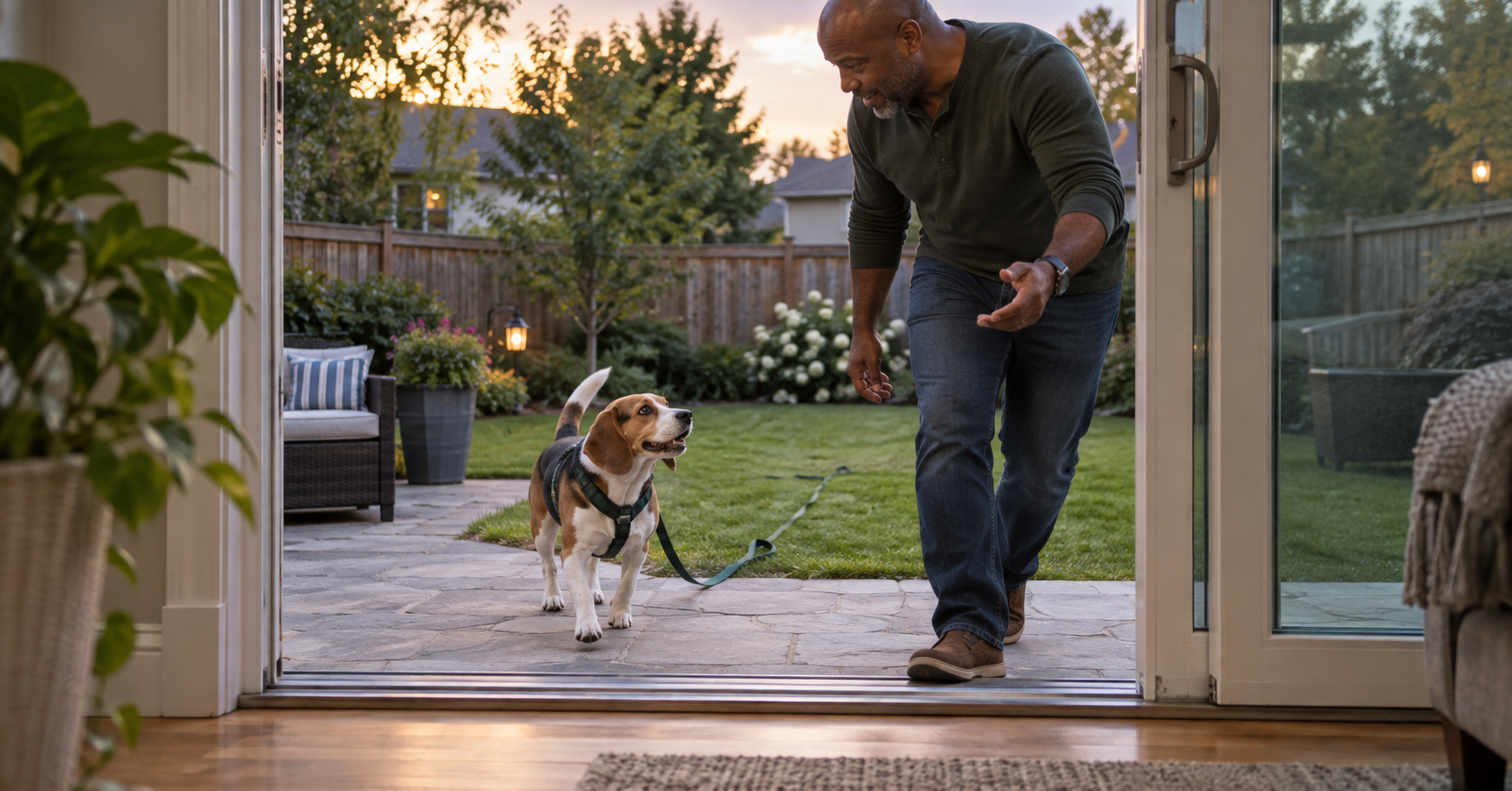
If your dog won’t come inside from the yard, the doorway may predict that outdoor freedom is ending. Make coming inside pay, stop poisoning the cue with a chase, and practice the transition when you are not already late.
This can feel personal at 10 p.m. while your dog studies you from the far side of the yard. But the dog may have learned a very practical sequence: coming to you means the door closes, the sniffing stops, and nothing interesting happens next. Repeating “come” from the doorway does not change that outcome.
Protect safety before training
Until the behavior is reliable, go outside with your dog in a securely fenced space or use an appropriately handled long line. A fence doesn’t teach recall, but you still need secure containment while you’re teaching the dog to return. Do not leave a long line dragging where it can snag without supervision.
If your dog is loose outside an enclosed area, do not test this article as an emergency strategy. A reliable recall is a separate safety skill. Our recall guide explains why controlled practice comes before off-leash freedom.
Change what happens after the dog arrives
For several easy repetitions, call your dog from a short distance, reward the arrival inside, and then sometimes release the dog back to the yard. The point is not to trick the dog. It is to stop making every successful response the permanent end of everything outside.
Use a reward that fits the moment: food, a favorite toy, a brief game, or quick permission to go back out when that is safe. The AKC’s recall guidance similarly warns against calling when you cannot follow through and then teaching the dog that approaching you ends the fun.
Practice a doorway loop
- Begin outside with your dog close enough to succeed.
- Move toward the doorway together rather than calling from the full length of the yard.
- Give the cue once, step backward through the doorway, and reward the dog after all four feet come inside.
- Pause for a small indoor activity: scatter a few pieces of food, offer water, or begin a short game.
- On some repetitions, use a separate release cue and return outside together.
Keep the front door closed or otherwise secured while practicing at a back entrance. Household traffic matters. A dog coming inside should not gain an accidental path through another open exit.
When the dog stalls
Don’t repeat the cue while walking toward the dog in a way that starts a chase. Make the next attempt easier. Shorten the distance, lower the yard’s excitement, or practice after the dog has had a reasonable chance to toilet and sniff.
Notice whether the hesitation is specific to the doorway. Slippery flooring, a closing door, darkness inside, a startling appliance, or discomfort stepping over a threshold can change the problem. New hesitation, movement difficulty, or pain needs veterinary attention. Fear of a particular entrance should not be handled by dragging the dog through it.
Your useful measure is not whether the dog finally gave up and came in. It is whether the dog turned promptly from an achievable distance, crossed the threshold willingly, and stayed engaged after entering. Repeat the short trip inside and sometimes back out, so entering doesn’t always end an activity your dog enjoys.