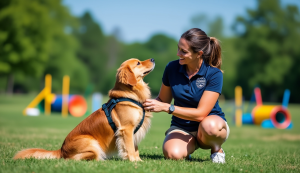

Obedience training teaches your dog what to do. Behavior modification changes the pattern around a problem such as fear, reactivity, guarding, or aggression. The two often work together, but one can’t simply stand in for the other. A dog may know sit, place, and heel and still lose the ability to use those skills when a particular trigger appears.
If you have been told your dog “just needs obedience,” pause and look at what actually happens. Is the dog missing a skill, or does the dog’s body, attention, and ability to recover change enough to create a different kind of problem? That distinction will point you toward more useful help.
Start with the moment the problem changes
Suppose your dog leaves the place bed when a visitor enters. If the dog stays loose, can respond to you, and simply has not learned to remain there through the distraction, you may be looking at a skill gap.
Now picture the same doorway with a dog who freezes, stares, growls, lunges, or cannot settle long after the person sits down. Asking for place may still be part of the management plan, but the missing command is not the whole problem. The visitor changes what the dog is able to handle.
This is the practical difference: obedience builds a behavior you can ask for; behavior modification addresses the conditions that make the dog’s response change.
Use three zones instead of one broad label
You do not need to diagnose the dog to describe what you see. Put the situation into one of three working zones:
- Green: the dog notices what is happening, can respond to familiar cues, and returns to ordinary behavior easily.
- Yellow: the dog’s mouth, movement, posture, or attention changes; familiar skills become slower, and recovery takes more effort.
- Red: the dog is lunging, panicking, snapping, biting, trying to escape, or otherwise unable to participate safely.
If the problem stays mostly in green, clearer teaching and practice may be the right starting point. If the dog repeatedly moves into yellow or red around the same trigger, treating the issue as ordinary disobedience misses important information.
The zones are not a diagnosis or a score. They help you answer a better question than “Why won’t my dog listen?” You are looking for the point where the dog stops being able to use what they know.
What obedience can—and cannot—do
Obedience gives you useful ways to communicate. A place cue can organize a visitor routine. Leash skills can help you create distance. Recall can help you move the dog away from trouble in a controlled setting.
But a completed command does not prove the dog feels safe or has recovered. A dog can remain rigid, watchful, or close to escalation while technically holding a position. If you focus only on whether the dog obeyed, you may miss the part of the behavior that tells you the situation is becoming harder.
That does not make obedience unimportant. It means the skill has to serve the larger plan rather than hide the warning signs.
Behavior work still needs teachable skills
Behavior modification is not simply talking about emotions while avoiding training. Dogs and owners need practical behaviors that make daily management clearer: moving behind a barrier, returning attention to the handler, settling at a workable distance, or leaving an area before the response grows.
The difference is the order of the questions. First ask what triggers the change, when the first sign appears, how much distance helps, how the dog recovers, and what the household can manage safely. Then choose skills that support those needs.
Bring a description a trainer can use
Words such as “aggressive,” “stubborn,” and “anxious” can mean very different things to different people. Before an evaluation, write down:
- the exact situation where the problem appears;
- the first change you notice in the dog’s body or behavior;
- the distance or event that makes the response stronger;
- what the dog can still do in an easier version of the situation;
- how long recovery takes; and
- any snap, bite, injury, escape, or veterinary concern.
That description gives the trainer a sequence to evaluate instead of a label to guess from. It also helps you notice whether the dog is missing a behavior, struggling around a trigger, or showing a sudden change that belongs in a veterinary conversation.
Know when the professional boundary changes
A sudden behavior change, sensitivity to handling, altered movement, appetite change, disrupted sleep, or another physical sign can point to a medical contributor. Only a veterinarian can diagnose medical conditions or prescribe medication, and training should not be used to explain away pain or illness.
Serious aggression, repeated bites, severe fear, or behavior that places people or animals at risk may require a professional with advanced behavior qualifications. Give the full history, even if the worst incident happened only once. Leaving out a bite or near miss makes it harder for anyone to recommend a safe next step.
Choose help that matches what the dog is showing you
If your dog needs clearer household skills, leash work, recall, or owner coaching and can practice without a serious trigger pattern, explore private dog training. If fear, reactivity, guarding, or aggression changes the safety of the situation, review NC K9’s behavior modification program.
The North Carolina dog training program guide compares the broader options, and the evaluation preparation guide will help you arrive with useful details.
You do not need the perfect label before asking for help. Notice the first change, identify the zone, and describe what the dog can still do. That gives the next conversation a much better place to begin.