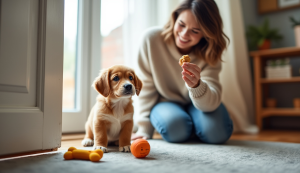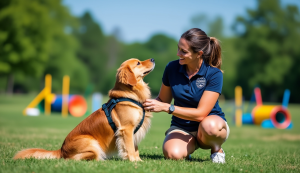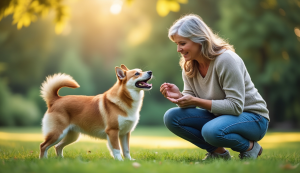

“Back up” is a practical cue for creating a little space without pushing, crowding, or dragging your dog. It can help at doorways, beside furniture, around equipment, and anywhere one or two backward steps make the next movement safer.
Teach it as a body-awareness skill in an open, nonslip area. The dog should discover the backward step; your hands and legs should not force it.
Define the first step
Before training, decide what will count. For the first session, success may be a weight shift backward or one rear-foot movement. Do not wait for several straight steps before marking anything.
Stand facing your dog with enough room behind them. Keep your shoulders relaxed and your path clear. If your dog is trapped between furniture or worried by your approach, change the setup.
Capture movement instead of walking into the dog
One option is to wait quietly for a natural backward weight shift. Mark it, then toss or place the reward so the dog can reset forward for another repetition.
You can also use a narrow visual lane made by two rows of stable objects placed far enough apart that the dog does not feel confined. Stand at the open end and reward one voluntary step backward through the lane. Remove the lane as soon as the movement becomes understandable.
Avoid marching into the dog until they retreat. That may produce backward motion, but it can also teach the dog that your forward body pressure predicts being crowded. We want the cue to mean “move your feet backward,” not “get away from me.”
Add the word after the movement appears
Once your dog is reliably offering one backward step in the setup:
- Say “back” once just before the step you can predict.
- Mark the first clean backward movement.
- Deliver the reward where your dog can reset without twisting.
- Pause before beginning the next repetition.
After several successful sessions, make your body prompt smaller. Stand more neutrally, say the cue, and wait briefly. If the dog does not move, return to the easier setup rather than repeating the word.
A marker word helps identify the exact foot movement before you can deliver the reward. Review how to keep visible food out of the cue picture if your dog moves only when your reward hand moves.
Keep the surface easy
Backward movement asks the dog to place feet where they cannot see as easily. Start on a surface with traction and no clutter. Do not practice near stairs, drop-offs, sharp furniture, hot pavement, or unstable objects.
If your dog sits every time, you may be leaning over them or holding the reward too high. Return to a neutral posture and mark a smaller weight shift. If the dog turns instead of backing, widen the practice lane and reward sooner.
For a dog who seems stiff, reluctant, uncoordinated, painful, or suddenly unable to move backward, stop and consult your veterinarian. Training should not be used to push through a possible physical limitation.
Add distance slowly
Build from one step to two before asking for a long reverse. Mark while the dog is still straight and comfortable. Several accurate short repetitions are more useful than one crooked, pressured sequence.
Then practice with you standing beside the dog rather than directly in front. That change matters if you want to use the cue near a doorway or on a walk.
You can pair the skill with a familiar destination. Ask for one backward step, then send the dog to a mat or invite a hand target. The article on teaching a hand target gives you a separate forward-moving cue so the two directions stay clear.
Use it before the space becomes tight
Do not wait until a door is closing, a person is carrying something heavy, or the dog is wedged between furniture. Cue the backup while there is room to succeed, then reward and complete the household task.
The practical measure is not how many feet your dog can reverse. It is whether one calm cue produces enough voluntary space for both of you to move safely.